Over a century ago, a boy would be born. No one would know it at the time, however, years later, he would go on to become one of Winnipeg’s business forefathers and a man who would leave an impact on the city long after his time.
This story begins on October 7, 1882, when Alexander Pollock was born in Edinburgh, Scotland to parents William Pollock and Jane Brown Jackson. Born into a large family, he would have eight brothers, including an identical twin, Thomas, as well as five sisters.
Pollock family portrait featuring five year-old Alexander second from the left in the bottom row (1887)
Being from a family of 15, it was likely that he experienced a fairly affluent upbringing. As a young adult, Pollock would enlist in the Royal Scots Guards in Edinburgh and go on to serve in the force for four years.
Royal Scots Guards embarking for South Africa (1899)
In 1904, Pollock immigrated to Winnipeg and made his living as a general carpenter and handyman. He spent his first few years in the city in a temporary residence on Selkirk Ave. Around 1906, he would purchase a lot on Lansdowne Ave. in the new development just north of St. John’s Park, then known as Lincoln Park.
An ad for the Lincoln Park development (1903), Winnipeg Tribune
Lincoln Park was named after the American firm Lincoln Park Realty Co., whose capital fuelled the early development of the area. Along with the proximity to the river and St. John’s Park, much of the appeal of the area came from its lush oak and elm groves.
Picnic in Lincoln Park at the corner of Lansdowne and Cochrane (1910), L.B. Foote
By 1909, Pollock was working for the construction company Brown & Rutherford. It was around this time that he would meet the woman that he would later become married to and spend the rest of his life with, Maud Gertrude Conklin.
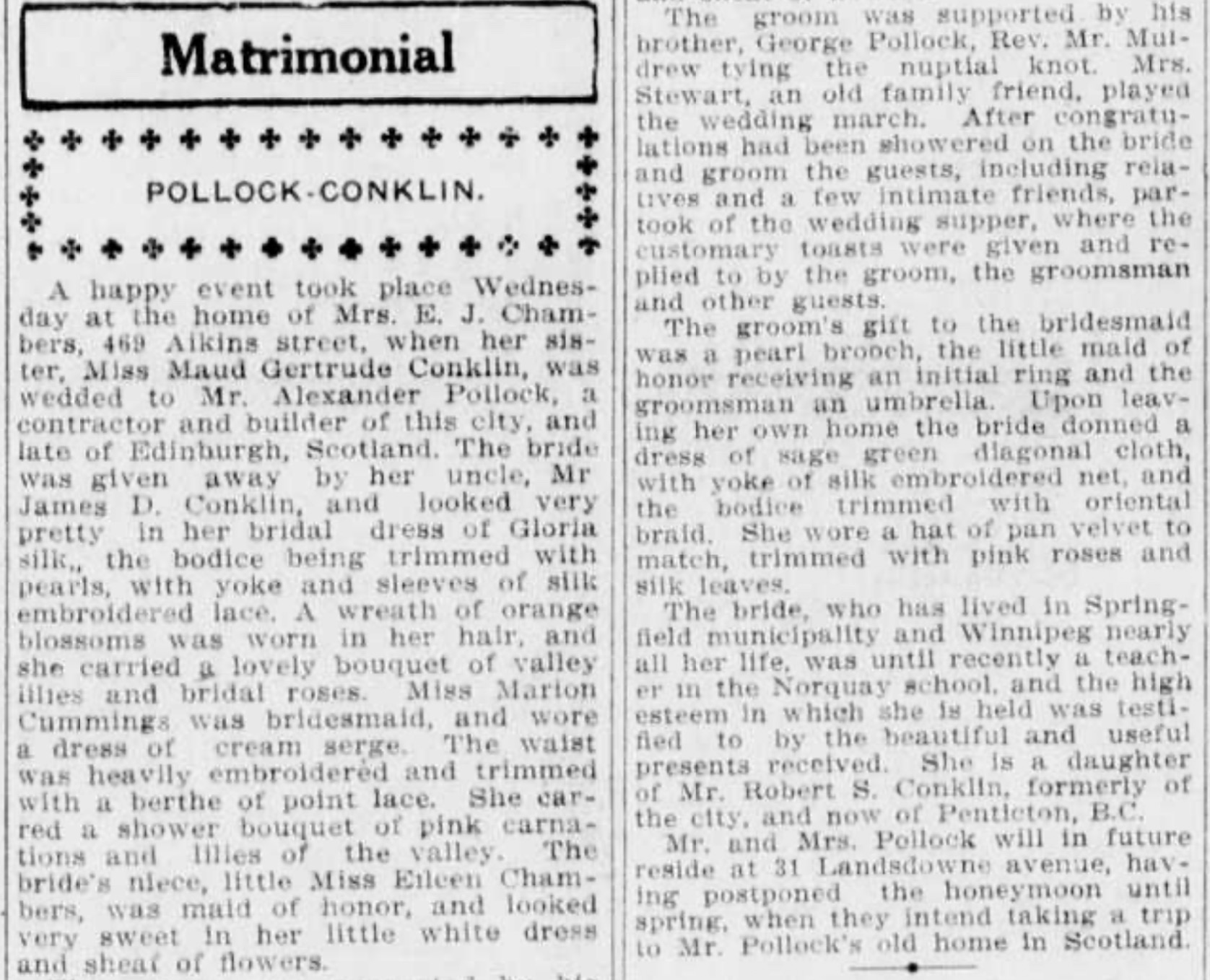
Pollock marriage announcement (January 21, 1911), Winnipeg Tribune
In 1911, the newly married couple would finally have a home of their own, on the lot Pollock had purchased years earlier on Lansdowne Ave. With a budget of $1900, it was the first complete building Pollock himself constructed.
31 Lansdowne Ave.
On the first block off of Scotia St., finished in a combination of shiplap siding on the main storey and and dark brown stained wood shingles on the second, the two-storey home features a steeply-pitched gable roof. The front porch is shielded by a small roof on the first storey, and the side of the home features a second storey gable dormer window.
A prime example of the style of homes Pollock would go on to build in the coming years, his style of architecture can be characterized as simplistic. His homes were built with no other purpose but to be functional and solid. And because of this streamlined approach, he was able to build more efficiently.
However, the Pollocks wouldn’t live here long. By the fall of 1911, Pollock had already listed the home for sale and began constructing several others in the neighborhood.
An ad for 31 Lansdowne (October 14, 1911), Manitoba Free Press
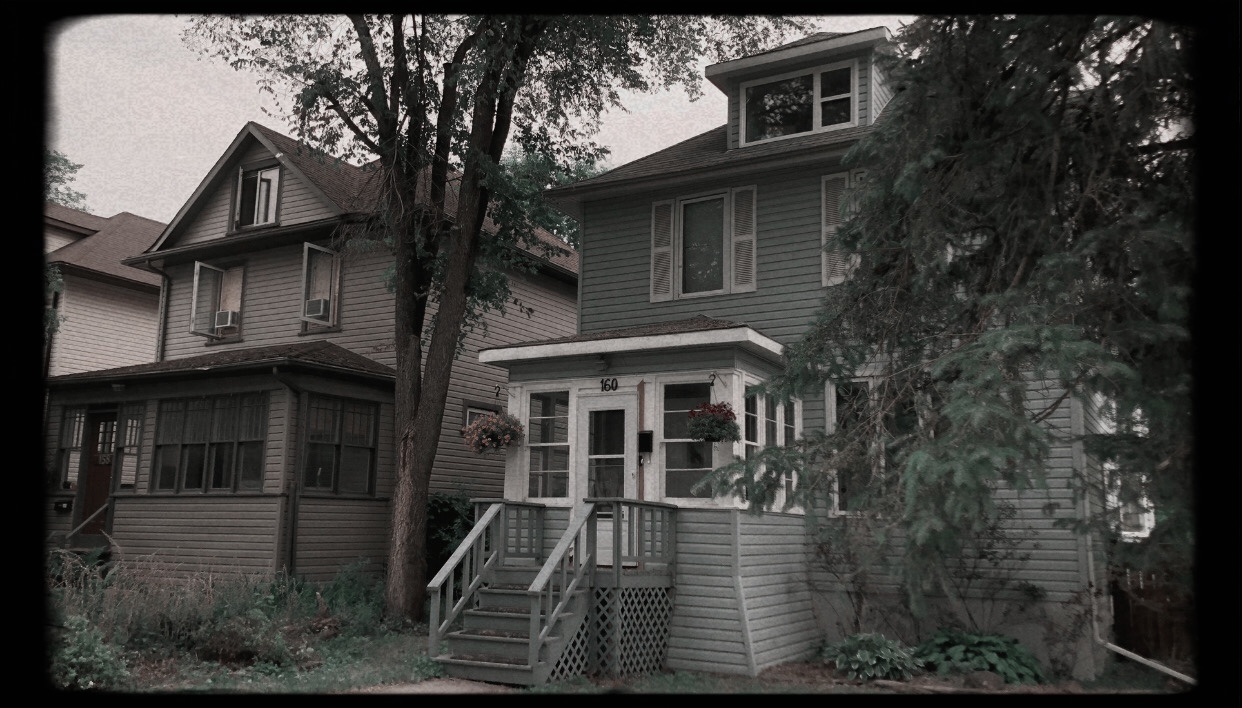
He purchased several lots on Matheson Ave., including a corner lot at modern-day Jones St. where he was building three homes, 156, 158, and 160 Matheson Ave. He would go on to sell 156 and 158, and move into 160 as his second, and longer term home.
An ad for one of his Matheson Ave. homes (June 9, 1913), Manitoba Free Press
The Matheson homes would be a continuation of his simplistic style of building, with 160 bearing two and a half storeys and a prominent dormer window on the front of the third storey.
158 & 160 Matheson Ave.
Some other unique features are the sealed off porch on the left side of the front, as well as a large set of bay windows on the first and second storey on the west side.
Continuing this trend of building, then selling homes, Pollock built homes on McAdam (33 and 35), Machray (135 and 139), O’Meara (9 and 11), and several others on Matheson Ave.
Ad for 35 McAdam Ave. (June 19, 1912), Manitoba Free Press
Blueprint for 11 O’Meara St. (April 9, 1913), City of Winnipeg Archives
Ad for 11 O’Meara St. (October 16, 1913), Manitoba Free Press
A view looking east at Main St. and Church Ave. with newly-built O’Meara homes in the background (1926), St. John’s Cathedral Archives, Harry Shave Collection
In 1914, the First World War broke out. Pollock’s two brothers George and Martin were among the first to enlist with the Canadian army, in September and October respectively, along with three others who would also serve. Pollock would instead complete and sell his current projects for around a year before enlisting. He would eventually enlist in the spring of 1916 as a part of the 184th Overseas Bettalion.
Pollock’s enlisting papers (March 16, 1916)
The Bettalion would be absorbed into the 11th Reserve Bettalion soon thereafter, and Pollock didn’t see as much in the way of combat as his other brothers. He returned home by 1917. In May of 1917, it was announced that his younger brother Martin was among the 1259 soldiers killed in The Battle of Fresnoy.
Martin Pollock’s obituary (May 16, 1917), Winnipeg Tribune
Only a year later, his elder brother George would too succumb to wounds from an earlier battle.
George Pollock’s obituary (August 12, 1918), Manitoba Free Press
Alexander stayed steadfast in his construction, and, during the 1920s, Pollock shifted his focus from residential to commercial building. One of the first examples would be the storefront block that would later bear his name. Built in 1922, 1403-1407 Main St. would be a one storey, three unit block.
Building plans for 1403-1407 Main St. (1922), Winnipeg City Clerks
The structure would be finished in a dark red brick, which would become a defining feature of Pollock’s buildings, and feature four parapets to separate each of the three units.
Pollock’s Hardware (2023)
Pollock would officially open a hardware store in the furthest north unit in 1922, then known as Keller’s Hardware, the store that would later go on to be called Pollock’s Hardware. He would simultaneously operate the store while continuing to build around the city.
A rare standalone ad for Pollock Hardware (April 29, 1937), Winnipeg Tribune
In 1925, Pollock embarked on his largest project to date. He would win the contract to construct a brand new apartment block on Edmonton St., facing Central Park at a cost of $80,000.
Announcement of Pollock’s successful bid for the contract (April 21, 1926), Manitoba Free Press
Part of the project’s requirements were the demolishing of already existing homes on the street, which were predominantly Queen Anne Revival style of houses.
A row of houses on Edmonton St. facing Central Park (1903), William A. Martel & Sons
The subsequent four storey and 31-suite apartment block, on a 50 by 115 foot lot and called the Pollock Apartments, were built soon after and would be styled far different than the homes on the block that came before it. Built with a similar approach to Pollock’s residential homes, with the help of his partner and architect Alex Melville, the block was designed with very few ornamental or stylistic embellishments.
Pollock Apartments (2020), George Penner
With a finish of red brick, the building features stone framing around the windows. Symmetrically designed, it also features four columns of elevated brick which form two larger bays on the sides and two smaller bays in the middle. The most visual interest comes from the crest where three stone and brick embellishments exist; two smaller diamonds on either side and a larger one along the middle with the ornamental pediment at the top of the roofline.
It was around this time that Pollock would also make his final move to the home where he spent the rest of his life, 114 Cathedral Ave. Built in 1905, this home was unique in that it was the only home that Pollock would ever own and live in that he did not himself build.
114 Cathedral Ave. (2023)
Built in a subtle Victorian style on a rubble stone foundation, the two and a half storey home features a finish of shiplap siding and fish scale shingles on the face of the third storey gable roof ends as well as the gable end of the front porch.
Unique features of the home include the enclosed porch with a large window on the right side of the front façade, the second storey bay windows, as well as the two small square windows on the second storey above the porch.
In 1928, Pollock would look to build his second apartment block just a few blocks south of his first. This one would be situated just south of Broadway Church, at 75 Kennedy St.
Kennedy St. and Assiniboine Ave. looking north toward Broadway (1906), City of Winnipeg Archives
The new block, constructed at a cost of $150,000 on Pollock’s 75 by 120 foot lot, was to stand 104 feet tall and feature 39 suites. It would come to be known as the Willingdon Apartments.
News of the new Willingdon Apartments (May 12, 1928), Manitoba Free Press and the permit issued (May 25, 1928), Winnipeg Evening Tribune
The building featured four levels and feature a similar brick and stone exterior to Pollock’s first apartment block. While also symmetrical, this building would feature seven distinct bays of brick elevation. Similar to the Pollock Apartments, the top storey features ornamented diamonds in stone, as well as six stone-capped parapets with a larger ornamented pediment in the middle.
Front façade of the Willingdon Appartments (1978), Murray Peterson
Part of what distinguishes it from the earlier Pollock Apartments is the arched entry roof which is supported by four oversized wooden brackets.
Willingdon Apartments (2023)
In 1929, Pollock would attempt his largest undertaking to date, and possibly the most sizeable mark he’d ever leave on the city. In Fort Rouge along Roslyn Rd., on a street of largely abandoned mansions and large single family homes, the effect of beginning of the Great Depression would set in.
A 1917 Fire Atlas of Fort Rouge showing the lot Pollock purchased and the single family homes along Roslyn Road (May 1917), Murray Peterson
Pollock purchased one of those homes, the former residence of lawyer Albert Clements Killam, at 1 Roslyn Rd. He soon began demolishing the existing property to make space for the new apartment block.
Initial announcement of the apartment block (March 30, 1929), Manitoba Free Press
The resulting two buildings, with 26 and 11 suites respectively, would come to be known as the Locarno Apartments. And at a cost of over $300,000 to construct, luxury would be the top priority. The exterior features a finish in Pollock’s trademark dark red William tapestry brick. And similar his two blocks before this, the Locarno blocks would feature a largely symmetrical look.
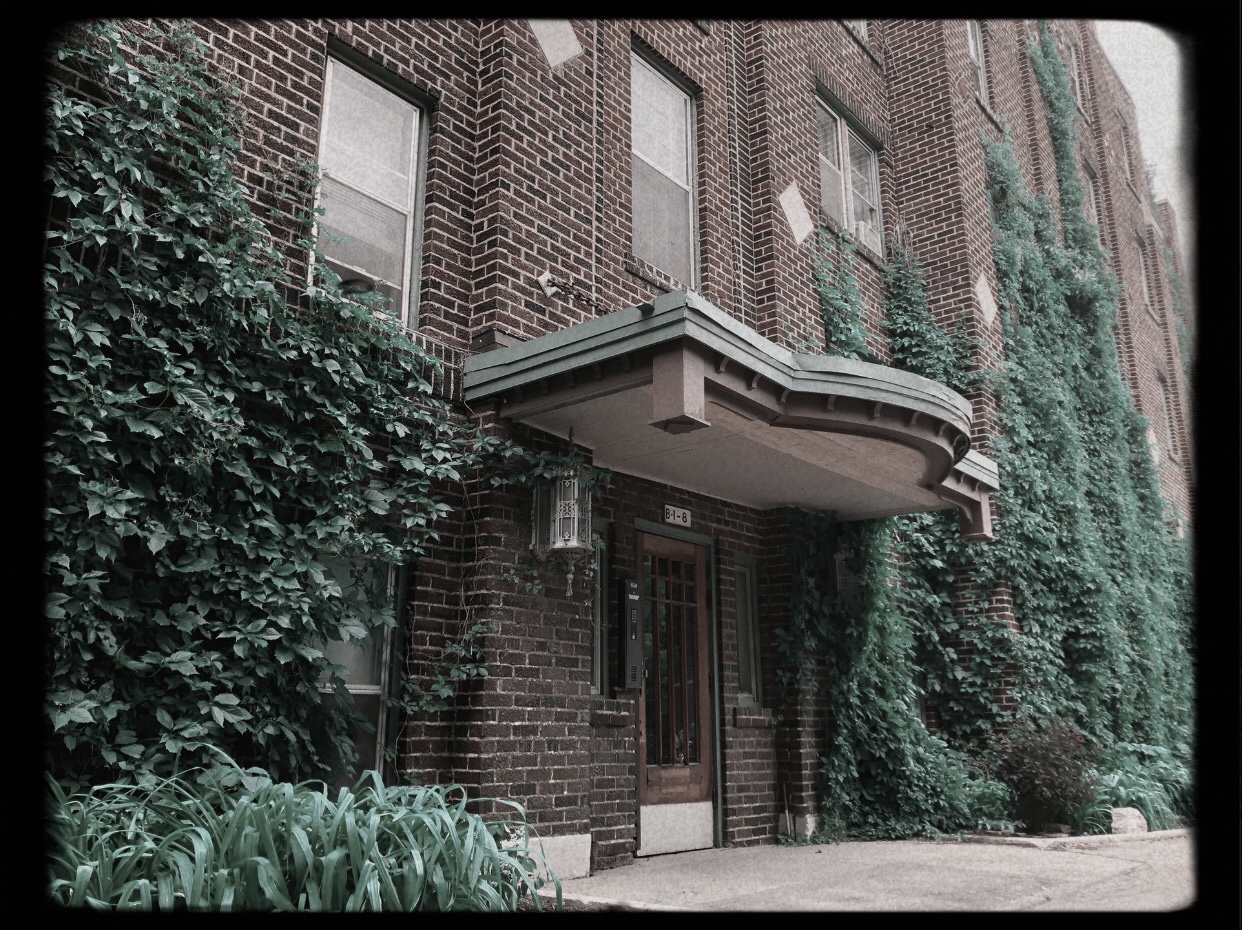
Locarno Apartment building B (2023)
Also similar to Pollock’s past blocks, the exterior of each were ornamented in stone and brickwork featuring geometric shapes along parapets, reminiscent of the hardware store, spanning the length of the building. Decorative pediments filled the gap between the parapets along the middle and corner of the structure. The entryways both front façades feature an overhanging roof with a subtle molding and ornate light fixture.
Locarno Apartment building B (2023)
The inside of the building, even more elaborate, featured luxuries for the time like intricate tile work along the stairway, brick fireplaces, arched doorways, and beautiful light oak flooring.

Inside of Locarno Apartment building B (2018), Murray Peterson
The Locarno Appartments was Pollock’s greatest and final achievement in construction. By the 1930s, between the three apartment blocks and his namesake hardware store he owned, Pollock would be among Winnipeg’s business elite.
Pollock meeting with other business leaders (September 2, 1936), Winnipeg Evening Tribune
With the constant revenue source of each of his buildings, by the age of 48, Pollock was able to comfortably hang up his tool belt and shift his focus and time from his businesses to his hobbies.
A few years earlier he had become a member of the St. John’s Curling Club. In 1930, he was elected president of the organization and lead the club for the following two years.
Announcement of Pollock being elected president (April 5, 1930), Manitoba Free Press
He would also go on to become a member of the Niakwa Country Club and Niakwa Lawn Bowling Club. Aside from his involvement in sports, Pollock seemingly kept a lower profile later in his life. In 1954, he sold the Locarno Apartments to an ownership group called Locarno Apartments Limited.
On November 3, 1957, Pollock passed away in the Grace Hospital at the age of 75.
Pollock’s obituary (November 4, 1957), Winnipeg Free Press
He would be buried in St. John’s cemetery.
Pollock’s gravesite (2023)
Even through death, however, Pollock was unable to avoid the limelight. Only two months after his death, it was announced that there was a problem with his will. In a surprising turn of events, the only will he had ever written was quickly scribbled on the backside of a 10.5 by 2.5 inch floor polish ad before he left on a trip earlier in 1957. It would leave his entire fortune to his wife.
January 16, 1958, Winnipeg Free Press
Coverage of Pollock’s will (January 16, 1958), Winnipeg Free Press
The sensationalized coverage of the disputed signature and validity of the will would end up making public the true extent of Pollock’s wealth. Having lived in his modest home on Cathedral Avenue for the past three decades, at the time of his death, his assets totalled in excess of $600,000; worth over $6.2 million today. Of note are the two apartment blocks he still owned, valued at $292,450, his cash on hand, over $294,000, and his Luxton hardware store, valued at less than $15,000.
Coverage of Pollock’s will (January 17, 1958), Winnipeg Free Press
In the end, the will was deemed genuine and his wife would end up with $300 per month tax free for the rest of her life, until she passed away on January 23, 1974. The two would never have kids to bequeath the fortune to, and given that Maud would have only used around $58,000 by the time of her death, it’s unclear where the rest of the fortune would go.
Pollock’s legacy is one of great significance. A first generation Scottish-Canadian, First World War veteran and hero, and hard-working entrepreneur who built three apartment blocks, a hardware store, and at least a dozen homes in the Luxton area that still stand today.
If there’s one thing that’s certain, it’s that, like the numerous buildings he would construct, his legacy is one built to last.